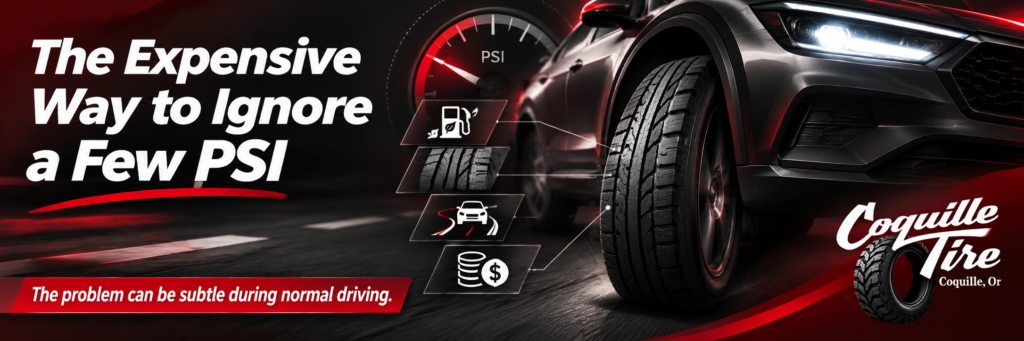
A tire does not have to look flat to be costing you money.
That is what makes a few pounds of tire pressure so easy to ignore. The vehicle starts, the tire looks normal, and the trip across town feels normal. Nothing dramatic happens, so it is easy to assume everything is fine.
But tire pressure is one of those small things that affects several bigger things at the same time. A few PSI can influence how the tire carries the vehicle, how much it flexes, how evenly it wears, how the vehicle feels, and how much energy it takes to keep rolling.
The Warning Light Is Not the Ideal-Pressure Light
One of the easiest assumptions to make is that if the tire-pressure light is not on, the tires must be at the right pressure.
That is not really what the warning system is telling you. The tire-pressure monitoring system is there to warn you when pressure has dropped far enough to be considered significantly low. There can be room between the vehicle manufacturer’s recommended pressure and the point where the warning light finally comes on.
In other words, no light does not necessarily mean ideal pressure.
That matters because a tire can be a little low without looking obviously low. It can also feel perfectly normal during easy driving. The difference may show up gradually instead – in fuel use, tire wear, steering response, or how the vehicle behaves when you ask more from it.
A Few PSI Can Cost You More Than Air
When a tire is underinflated, it flexes differently and creates more rolling resistance. The engine has to work a little harder to move the vehicle down the road. One trip may not feel different, but fuel is something you buy over and over again.
Pressure also changes how the tire supports the vehicle and meets the pavement. When that relationship is not what the vehicle was designed around, tread can wear differently and the tire may build more heat. Over enough miles, a small pressure problem can become an expensive tire-life problem.
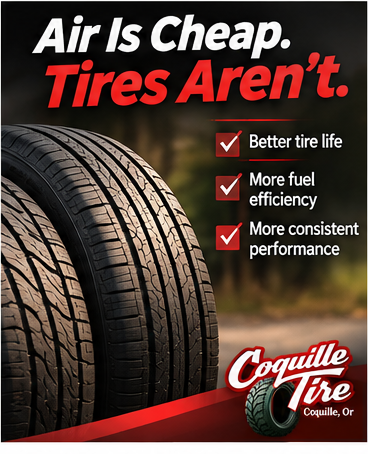
That is why the expensive part of ignoring a few PSI usually is not the air. Air is cheap. Fuel, tires, and repairs are not.
It Can Still Feel Fine
This is where ordinary driving can fool us.
A slightly low tire may not make the steering wheel shake. The vehicle may not pull. You may not hear anything unusual. If you are driving gently on a dry road, there may be nothing that feels urgent.
But normal driving does not ask very much from the tire. A harder stop, quick lane change, loaded vehicle, wet corner, or unexpected obstacle asks for more. That is when the condition of the tire has more opportunity to show up in the way the vehicle responds.
We will keep coming back to that idea throughout this series: how something behaves during an easy drive does not always tell you how much margin is available when conditions change.
Use the Number the Vehicle Was Built Around
The correct pressure is not the maximum pressure printed on the tire sidewall. For normal vehicle operation, use the vehicle manufacturer’s recommended cold tire pressure. You will usually find it on the Tire and Loading Information label on the driver’s door jamb or in the owner’s manual.
And ‘cold’ matters. Tire pressure changes as the tire warms up from driving, so the best comparison is made before the vehicle has been driven for several hours.
That makes a tire-pressure gauge a pretty inexpensive tool for protecting a much more expensive set of tires.
Protect What You Already Paid For
You already bought the vehicle. You already bought the tires. You are already buying the fuel.
Keeping the tires at the pressure the vehicle was designed around is not about obsessing over a number. It is about getting the handling, tire life, fuel economy, and performance you already paid for.
And if a tire keeps losing pressure after you add air, that is useful information too. The answer is not to get used to topping it off forever. Finding out why it is losing air keeps a small maintenance issue from becoming background noise.
A few PSI may not look dramatic from the driver’s seat. That is exactly why it is so easy to ignore – and why ignoring it can get expensive.