Modern vehicles are pretty impressive.
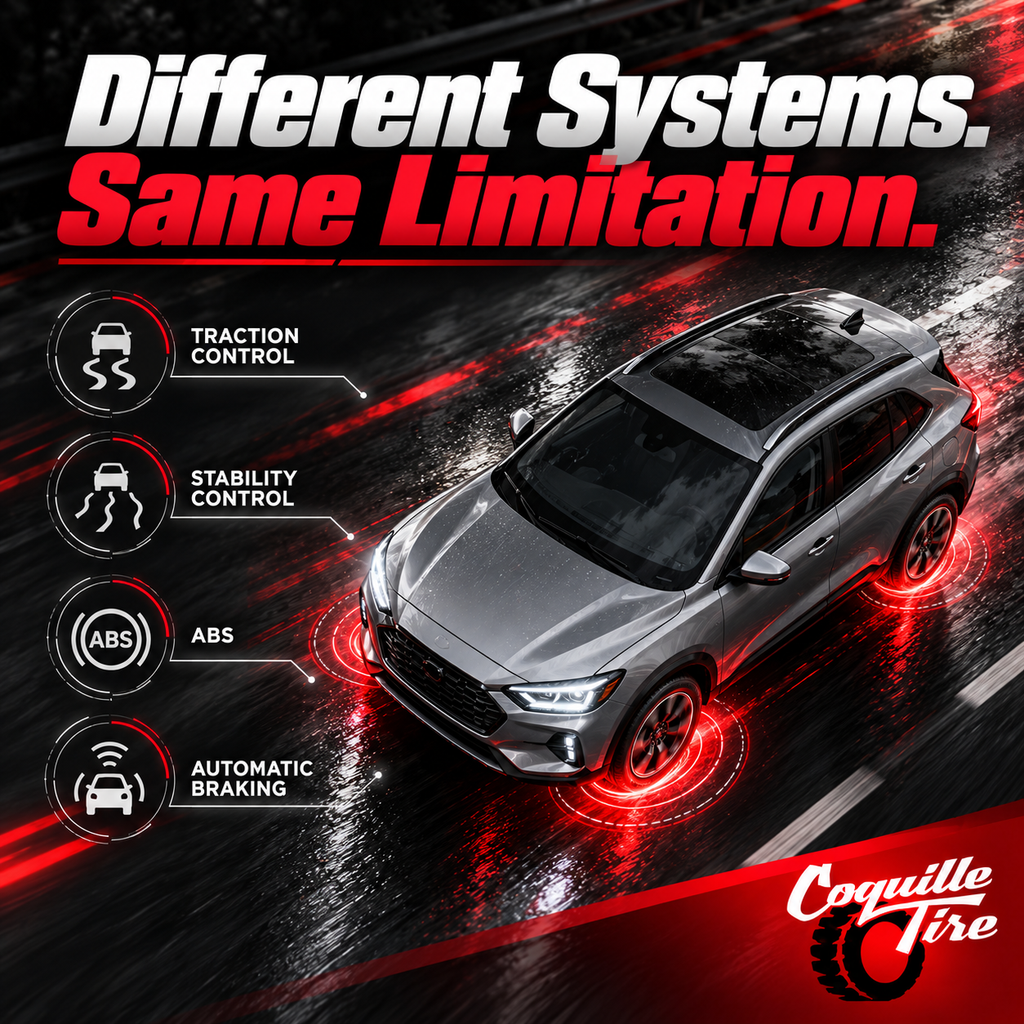
They can warn you when you drift out of your lane, help control wheel spin, keep the vehicle more stable in a turn, and in some cases apply the brakes if they think you’re about to hit something.
It’s easy to start thinking the vehicle has everything covered.
But there’s still one thing between all of that technology and the road:
Your tires.
Every correction the vehicle makes still has to reach the pavement through the tires. That means all of those systems can only work with the traction, tire condition, and road conditions available at that moment.
And most of the time, ordinary driving doesn’t tell you much about where those limits are.
Normal Driving Doesn’t Ask Very Much From Your Car
Think about a typical trip across town. You accelerate normally, brake gradually, and take corners at a comfortable speed.
Under those conditions, a lot of things can seem perfectly fine.
A tire can be a little low on air without the vehicle suddenly becoming difficult to drive. Tread can be getting worn without creating a dramatic change in the way the vehicle feels on a dry afternoon. A developing problem may simply not be noticeable because you haven’t asked very much from the vehicle.
That’s why these things are easy to take for granted.
The better question isn’t just, “How does my vehicle feel during normal driving?”
It’s, “How much capability is still there when I suddenly ask for more?”
Automatic Braking Still Has to Physically Stop the Vehicle
Automatic emergency braking is a good example.
The system may recognize that something is happening ahead and apply the brakes faster than you would have. That’s useful technology.
But once the brakes are applied, the vehicle still has to slow down. The tires still have to grip the road, the brakes still have to do their job, and speed and road conditions still matter.
Automatic braking doesn’t remove stopping distance from the equation. It helps the vehicle react to the situation.
What happens after that reaction still depends on what the vehicle has to work with.
That doesn’t make the system less valuable. It just means the technology and the mechanical condition of the vehicle are working together.
ABS Doesn’t Create Traction Either
Anti-lock brakes are another feature people often know is important without necessarily knowing exactly what it does.
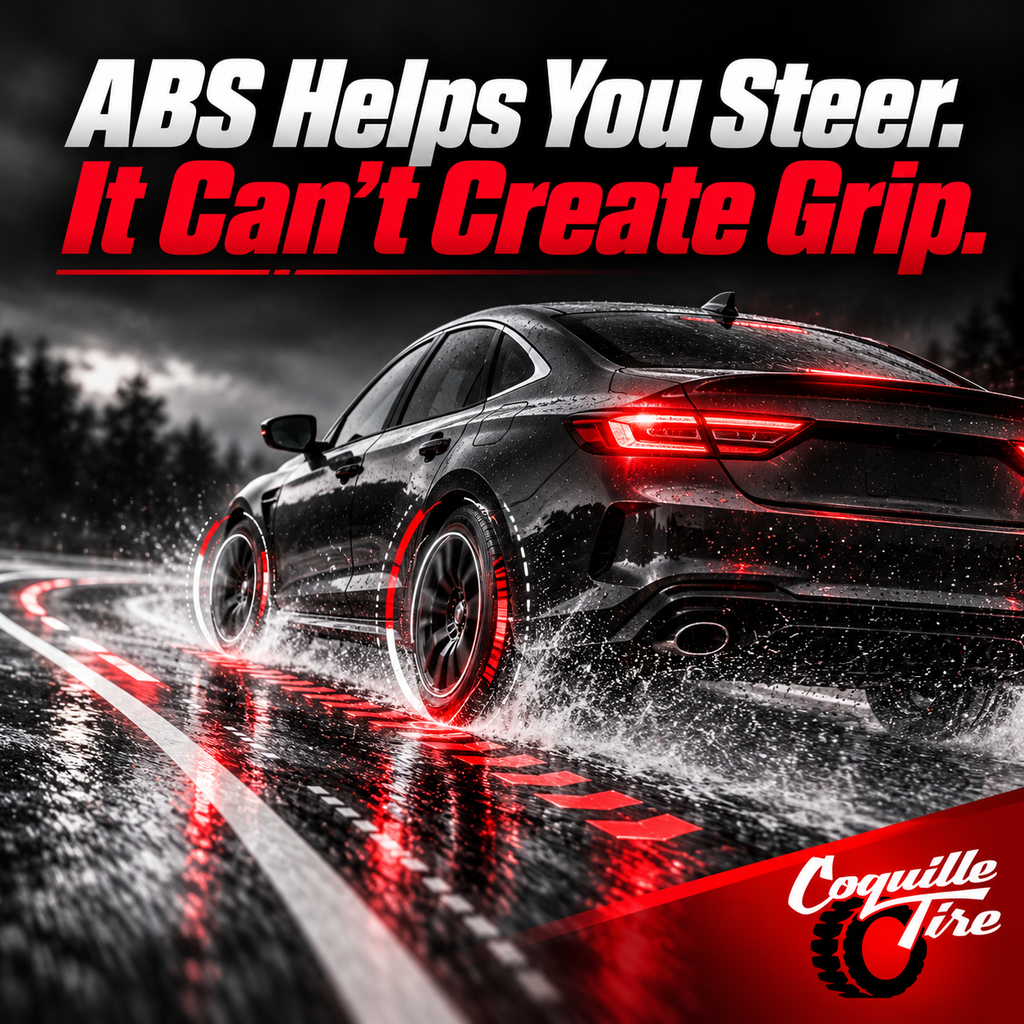
ABS is designed to keep the wheels from simply locking and sliding during hard braking. That can help the driver maintain steering control while braking.
But ABS can’t create grip that isn’t there.
If traction is reduced because of tire condition, tire pressure, or the road surface, the system still has to work within those limits. The same is true of traction control and stability control.
They’re useful tools, but they still depend on the physical condition of the vehicle.
The Part You Can’t See From the Driver’s Seat
This is where tires get overlooked.
Most people aren’t interested in talking about a tire’s contact patch or tread footprint. They care about whether the truck feels planted in a curve, whether the car stops the way they expect, whether the steering feels vague, or whether the vehicle still feels confident on a wet road.
Those things are all connected.
Air pressure changes the way the tire carries the vehicle and meets the road. Tread condition affects available traction. Wear patterns can change how the vehicle feels.
And sometimes none of that becomes obvious until the vehicle is being asked to do something outside the ordinary.
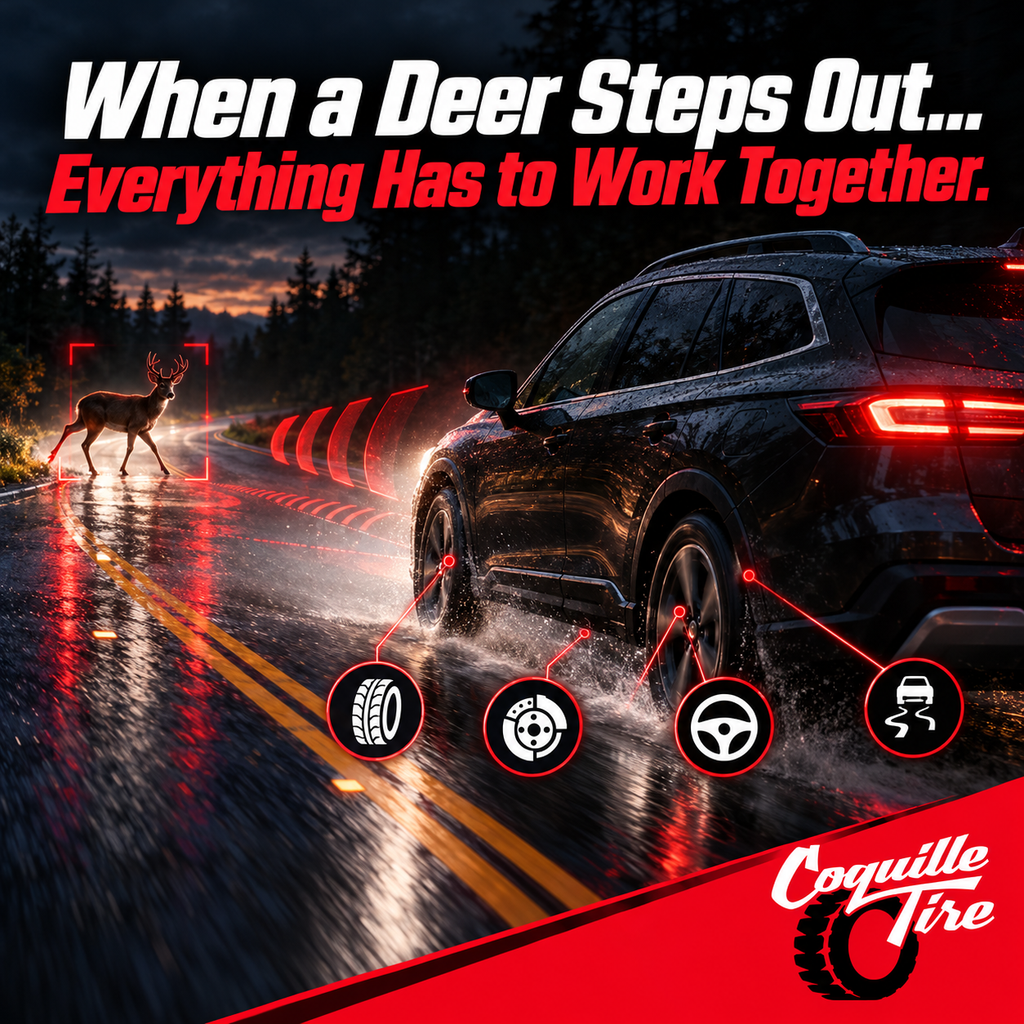
A hard stop, quick lane change, wet corner, or unexpected obstacle is when the margin really starts to matter. Around here, that unexpected obstacle may be a deer that suddenly decides the road belongs to it.
Think of It as Knowing What Your Vehicle Can Do
People who prepare for emergencies at home usually don’t do it because they expect a disaster every Tuesday. They do it because they want to know what they have available if normal life gets interrupted.
Your vehicle isn’t much different.
You don’t need to drive around expecting something bad to happen. But it makes sense to know what condition the vehicle is in before the day comes when you ask it to do more than commute quietly down the road.
That means knowing whether the tires are properly inflated, whether there’s enough usable tread, whether the wear looks normal, and whether the vehicle has started pulling, wandering, or feeling different.
Those are simple things, but they tell you more about the vehicle’s actual condition than simply knowing it has ABS, traction control, or automatic braking.
Technology Works Best When the Vehicle Does Too
None of this is an argument against modern safety systems. They’re useful, and in many situations they’re remarkably good.
But they’re still part of a larger system.
Sensors recognize what’s happening. Computers decide what to do. Brakes apply force. Steering and stability systems make corrections.
And eventually, all of those instructions reach the same place:
the tires touching the road.
That’s why tire condition matters even on a vehicle loaded with technology.
You paid for those systems. You might as well give them the best mechanical conditions to work with.
And tires are only part of the stopping-distance story. Brake condition matters too, and sometimes a brake problem can stay quiet during ordinary driving until the vehicle is asked to work harder.
That’s another story, and one we’ll get into separately.
For now, the main point is simple:
Don’t judge everything your vehicle can do by how it behaves when you’re barely asking anything from it.
A vehicle can feel completely normal on an ordinary drive and still have less margin than you think when the road, the weather, or the situation suddenly asks for more. We offer free vehicle inspections to help spot potential under-performance that hasn’t revealed itself yet.